#ad – this guide contains affiliate links. If you buy through them, HomeTechFit may earn a commission at no extra cost to you.
A portable power station is a large rechargeable battery with normal UK plug sockets on the front. When the power goes off, it keeps your Wi-Fi, phones, lights and even a fridge running. Unlike a petrol generator, it’s silent, gives off no fumes and is safe to use indoors.
The hard part is choosing a size. Buy too small and it runs out in hours; buy too big and you’ve spent money on capacity you’ll never use. This guide explains how to work it out without the jargon.
The two numbers that matter
- Capacity (Wh, watt-hours): how much energy the battery holds. This decides how long things will run.
- Output (W, watts): how much power it can deliver at once. This decides what you can plug in. A device that needs more watts than the output rating won’t run at all.
Most power stations also list a surge figure, which is a short burst of extra power for appliances like fridges that need a kick to start up.
A quick way to estimate run time
Divide the capacity by the watts your devices use, then knock off around 15% for conversion losses:
Run time (hours) ≈ capacity (Wh) × 0.85 ÷ device watts
For example, a broadband router using around 12W on a 299Wh power station: 299 × 0.85 ÷ 12 ≈ 21 hours.
Wattage varies between models, so check the label or plug-in adapter on your own devices. These rough figures are a useful starting point:
- Broadband router: around 10–15W
- LED light bulb or lamp: around 5–10W
- Phone charge: around 10–15Wh per full charge
- Laptop: around 30–60W while charging
- TV: around 50–100W
- Fridge-freezer: averages roughly 40–70W over time, because the compressor switches on and off, but needs a higher burst to start
What a power station won’t sensibly run
Anything that makes heat uses a lot of power. Kettles, toasters, fan heaters, hair dryers and electric showers typically draw thousands of watts. Some larger power stations can boil a kettle once or twice, but it’ll drain a big share of the battery. In a power cut, save the battery for things that keep you connected, lit and your food cold.
Which size fits your home?
Around 300Wh: phones, Wi-Fi and lights
Right for flats, people living alone and anyone whose main worry is staying connected. A 300Wh station will keep a router going for most of a day, charge phones many times over and run a lamp through the evening.
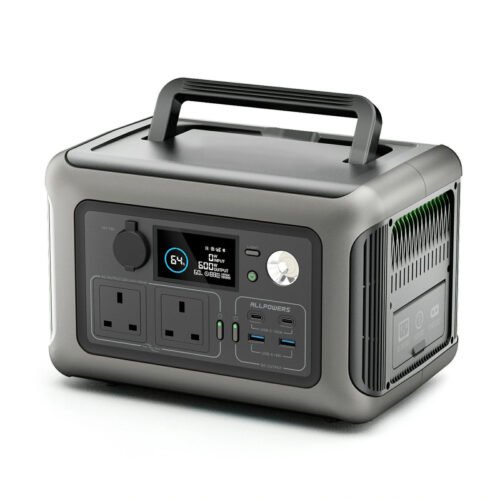
Our pick: ALLPOWERS R600 (299Wh, 600W)
A compact UK-plug unit with a LiFePO4 battery rated for thousands of charge cycles, 600W output and eight ways to charge devices, including UK sockets, USB-C, USB-A and a wireless charging pad. Its UPS mode means you can leave your router plugged into it, and it switches over automatically when the power drops, so your Wi-Fi doesn’t even blink. It recharges from the mains in about an hour, and can also top up from solar or a car socket.
Around 1,000Wh: the fridge as well
Right for families, longer power cuts, or homes where someone needs a device kept running. At this size you can keep a fridge-freezer cold through an evening outage while still running Wi-Fi and lights.
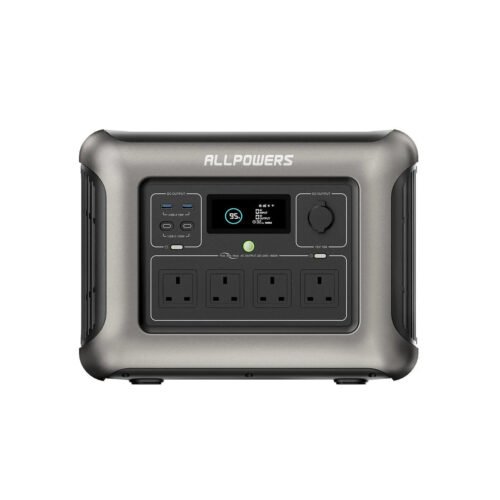
Our pick: ALLPOWERS R1500 LITE (1056Wh, 1600W)
A 1056Wh LiFePO4 battery with 1600W output and a 3200W surge, enough to start a fridge-freezer. It has a UPS function that switches over in 15ms, recharges from the mains in around 1–1.5 hours (or from up to 650W of solar), and runs at around 35dB, which is quiet enough for a living room. The cells are rated for 3,500+ cycles and it comes with a 5-year warranty from a UK warehouse.
Using the rough figures above, a router and an average fridge-freezer together (around 60W) would run for roughly 15 hours on the R1500 LITE.
If someone relies on medical equipment
A power station can be a useful backup for equipment like a CPAP machine. Don’t rely on it alone, though. If anyone in your home depends on electricity for medical equipment, sign up for your energy supplier’s and network operator’s free Priority Services Register, so they know to give you extra support during a power cut. Check the equipment manufacturer’s guidance on running it from a battery.
Cheaper ways to cover the basics
If a power station is more than you want to spend, you can still cover light and news for very little:
- A rechargeable lantern like the BougeRV T1 lights a whole room for up to 90 hours on low, and extends to work as a floor lamp.
- A wind-up solar radio gives you news updates, a torch and an emergency phone top-up without any mains power at all.
- A charged power bank keeps a phone going for a day or two.
Looking after a power station
- Keep it charged. The whole point is that it’s ready. Top it up every few months, or leave it plugged in if it has a UPS mode.
- Store it indoors. Batteries don’t like freezing garages or hot lofts.
- Do a test run. Once, on a normal evening, try running your router and a lamp from it so you know how it works before you need it.
Frequently asked questions
Can a power station run a fridge in a power cut?
Yes, if it’s big enough. Look for around 1,000Wh capacity and a surge rating high enough to start the compressor. A smaller 300Wh station can run a fridge for a few hours at most.
Is a power station safe to use indoors?
Yes. Unlike a petrol generator, a battery power station makes no fumes, so it’s safe to use inside your home. Keep it on a flat surface with space around it for ventilation.
What does UPS mean on a power station?
UPS stands for uninterruptible power supply. You leave your device plugged into the power station while it’s plugged into the wall. If the mains power drops, it switches over automatically, so things like Wi-Fi and security cameras keep running.
Can I charge a power station with solar panels?
Both ALLPOWERS models we list can be charged from solar panels as well as the mains and a car socket, which is useful for longer outages.
What should I do first in a power cut?
Call 105 for free to report it and get updates from your local network operator. Our guide on what to do in a power cut covers the rest.
Be ready before the next storm. Browse the Emergency Kit hub for power stations, lanterns, radios and ready-made kits for UK homes.